Sunday, December 1, 2024

Traveling In The Old Days


Palmyra Courier-Journal

April 30, 1909

   “Traveling in the Old Days,” is the subject of the letter from our esteemed correspondent who has been writing on “Palmyra In the Early Fifties.” His letter, published in today's Issue of The Courier, will be found very interesting.

   Indeed, as it describes the mode of traveling in this section fifty and sixty years ago, when railways were almost unknown.

He refers pleasantly to the old Erie canal packets, and the memory of many of our citizens will go back to those days and the luxurious accommodations when the packet boats afforded to passengers traveling to Rochester, Buffalo and other points. In those far-away days the packet captain was a man of great importance, and to know him personally was a treat which but few enjoyed. Bat the packet captain was always a gentleman, and the comfort of his passengers was always his chief desire.    

   Even the Pullman dining cars of today cannot offer a better service than was enjoyed by the packet traveler sixty years ago. 

                                            ______


              Traveling In The Old Days

              ____

Some Interesting Reminiscences From

    a Former Resident of the Village

                          ____

   I wonder how many of The Courier’s readers remember the palmy days of the Erie Canal, when it was the chief avenue of travel through the state between Albany and Buffalo. Even after several lines of railroad were in operation, through the Mohawk valley and west to Syracuse and Auburn, the Erie packer boat was largely organized. And it was a jolly way to travel.

   The packet of sixty-five years ago was a trim craft, with graceful lines, and cutting the water at a good speed for that day - they were not like the strenuous times of the present. Why, we would leave Rome at nine in the evening and be in Syracuse  for breakfast the next morning - a distance of forty miles!

   They used to ring the bell at the landing just east of the James street bridge, and a crowd of young people gathered to “see the packet in.” And it was not so slow an affair. With the three horse tandem team at a round trot, with crack of the driver’s long lash and a bugle fanfare the boat would make the landing in a rocking swell. Don’t you remember Captain Vedder?

   On board it was great fun to watch the waiter boys pull out the extension tables in that long cabin and sling the dishes into position. And wha savory odors issued from the tiny caboose where the black cook was dishing up the dinner, utilizing stove and table and often the floor for that purpose.

   But what transformation at night when they put up those hammock berths, end to end and one above the other, lower and middle and upper, along the cabin sides, and the swinging berths in the center.  Did you ever have the one above you give way without warning and precipitate a big man on top of you? I remember a small boy who did, and he was ever after distrustful of such sleeping gear.

   But people not in a hurry often journeyed by “line boat,” as the boats of the regular freight lines were called. Many a time did the writer come and go between Rome and Lyons and Palmyra in this way. Often these boats were new and neat with their white paint and green blind. There was a comfortable passenger cabin forward, while the dining cabin and kitchen were aft; it was necessary to cross the upper deck in passing back and forth, the big midship space being needed for freight.

   There was a boat called “the Musician”that was a great favorite and parties would wait several weeks for the privilege of making the trip in it; it was owned by the Blakeslee family, all the members of which were musicians and there were daily entertainments during the “voyage.” This boat had red window blinds all along its sides. We youngsters always looked forward with pleasure to these canal trips, so full of novelty. There were many things to see and plenty of time in which to see them as we moved leisurely along through countryside, hamlet and village.

   We were passing other craft; line-boats and scows, and now and then a trim and aristocratic packet - why, one of those boats could cut a big swell than the flyers and limited expresses of these days. The eastward bound boats were heavily loaded, sometimes to their gunwales, and their teams of horses or mules on the towpath would seem scarcely to move. Some boats would have a cargo of corn, and we could see through the windows the bulk of the grain, yellow as gold, and reminding us of our country days, of corn husking and of samp and hominy and hasty pudding. (Note: Samp and hominy are foods derived from kernels of corn.)

   Again here would be loads of flour or salt in barrels piled tier on tier on he deck. At times we would meet scow after scow, square bowed and logy, piled high with bright new lumber; sometimes a load would lean, like the famous old Tower of Pisa, and we wondered the boat did not “turn turtle.”

   In passing, one boat was obliged to cast off its towline and to run over the line of the other boat, and this operation was always interesting. The crew would hail each other as the boats met, or occasionally there might be an ill-tempered encounter, but generally of words only.

   The liners had regular stations at which they changed teams, but many of the boats carried their own horses in a little cabin stable forward, and it was interesting to see them lay the bridge and pass the animals to and from the towpath. Now and hen a great raft of lumber would be met moving slowly toward the seabed and made up of many sections; on one of these would be a small living cabin, and on another a stable for horses.

   Sometimes the women would be preparing the meal from an outside fire, the column of blue smoke curling upward from the short stovepipe. At the locks the sections would have to be unbent and ru through separately, a very tedious operation.

   Passing through a lock was always a sensation; to sink down and down between the dark damp walls was a trifle scary, and we were always glad to emerge into the light and the open water.

   Do any of my readers remember the Montezuma marshes, or have they passed through them in the night or the white mists of an October morning? The wide water spaces, the stretches of flags and rushes, and the multitudinous chorus of the frogs are weird memories of this dismally romantic tract.  But had! I hear the breakfast bell and smell the frying sausages and buckwheat cakes, for good things to eat an an appetite were always accompaniments of a canal boat journey.

   Well, presto change! The writer remembers the old short cars of the “Syracuse and Utica Railroad.” They were about the length of two or three of the old-fashioned stage coaches, and the compartments, each with two broad seats facing each other, were entered by side doors. Along the outside ran a foot-board, and on this the conductor would pass to collect his fares; no tickets were used, but each paid in money through the door window, the cars stopping for the purpose just outside the station. Of course everyone was honest in those days.

   The railroad was but a crude affair, the tracks being only long strips of strap iron spiked to wooden stringers. Sometimes an end would work loose and a “snake-head" be thrust up through the floor of a car. The first “T” rails were a great curiosity. The cars were very noisy and people were obliged to shout to one another when attempting conversation.

   The first approach to a longer car of which I have any knowledge of was on the Auburn and Syracuse railroad. The windows were diamond-shaped and the side of the car looked like a somewhat compressed checkerboard. The effect was unique and pleasing. This must have been about 1840. Soon after a new car was placed on the line east of Syracuse. Our next door neighbor in Syracuse was a conductor and it was with him that I took my first ride i the new cars. However, it was many years later before anything like the present palatial coaches came into use.

    So much about the canal and railroad of former days. But for the real romance of travel the reader must go back with me to the old four-horse thorough brace stagecoaches that sixty years ago wound their way through the Mohawk valley or climbed  the hills along the state roads of northern New York. Those glorious old coaches! Splendid in red or yellow or green and gold; drawn by their spanking teams of bays or grays or black, and driven by Jehus as well known and as well noted as so many major-generals. There is living today many a gray-headed doctor or professor who can remember when the height of his boyish ambition was to drive a four-in-hand stage coach!

  The inside of the coach was of substantial leather upholstery and the three broad seats made room for nine good people. With well-balanced load - inside seas all taken, a full boot behind, and one or two men of good avoirdupois on the seat with the driver - such a coach rode steadily enough; and withe a congenial company, fair roads and a careful driver, nothing could be more delightful. But once upon a time a small boy was the only passenger. In such a coach for some distance he kept no journal of the trump but had he done so he might have found difficulty in saying upon what particular seat he made the journey.

   I have only to shut my eyes tonight and I am back again to a little village in the Black River country of Northern New York just as the sun is going over Tug Hill. A cloud of dust towards Martinsburg signals the coming of the southern mail.

   The driver sounds his horn, a long-drawn crescendo blast, and the villagers flock to doors and windows. Down the long hill comes the coach and we can hear the rasping of the foot-brakes on the wheels; it rumbles over the creek bridge; with the horses at a round canter it rattles up the street, and with a final crack of the long whip the driver pulls up at the village stage house, the leather thorough-braces rocking the coach like a ship in a storm.

   The teams are unhitched and the steam horses file away to the stables while the fresh relays come out to take their places. The old postmaster, bareheaded, and in his shirt sleeves, comes across the street and exchange mail pouches with the driver.

   Two or three passengers alight while others enter, and the partly Boniface closes the door with a bang. The driver gathers up the reins, the leaders prick up their ears, and with a word of command and a crack of the whip the coach is off up the street, the villagers go their several ways, and the twilight falls in restful quiet on the little town.


Friday, October 18, 2024

"Slab City" in Cortland County

 Syracuse Post-Standard

September 24, 1933


  Forgotten Villages


Dutch Made Slab City

Thriving Little Hamlet

                      _____

First Grist Mill Now Used as Garage,

        Another Still Being Operated

                     ____


               By T. Elmer Bogardus

   One hundred and thirty-six years ago a pioneer struggled through the forest and undergrowth of southern Onondaga county sleeping by day and traveling by night to avoid hostile Indians.

   It wasn’t a long journey. It started at mopey Hill and ended on the top of a steep hill forming Tully valley and overlooking the swampy Tioughnioga river a few miles below the present Tully village.

   But although short, it was a difficult passage, and the man blazed a trail as he progressed so he could find his way back and not become lost in the maze of trees. The pioneer was named James Cravath, according to legend, and he was seeking the mile-square of land given him by the government.

   When he reached the hill he looked down and saw below him more woods and the swamp and, disheartened, turned back to Pompey Hill. The prospect of hewing those trees and conquering that swamp was too much, for the man already had grubbed some land in Pompey. But he returned the following year and built the town’s first home, a log cabin, on East Hill.

               Dutch Settled in Valley

   A year later came the hardy Dutch from Coxsackie, who heard  who heard Cravath had had not accepted is land grant. More fearless perhaps and more eager for homesteads, the Dutch went down into the valley and settled. 

   There was started Slab City, now a forgotten village on Route 11 in the town of Preble, Cortland County.  Slab City is a hamlet in the town of Preble, Cortland County, on US Route 11 southeast of Preble village.The Dutch came in 1798, and it wasn’t long before a thriving little hamlet was in the making.

   A school, the first in the town of Preble, was built in 1801 and the first teacher was Miss Ruth Thorp. The original building with few changes still stands, since it has been abandoned for six tears biome the children going to Homer for classes.

   Slab City received its name from the sawmills which sprung up on the Tioughnioga river. But those mills have mostly faded into history with the exception of the old Slab City cider, saw and grist mill owned and operated by Clayton Smith.

                           Grist Mill Built

   The first grist mill was built in 1805 by Samuel Woolson and rebuilt in 1827. The building is still intact and used as a garage and storehouse on the farm of Frank Fox.

   Directly behind the old mill are stone ruins of of a sawmill and the site of the dam which furnished water power many years ago. A cheese factory was built in 1863-64 by Moses and William Tallman , one of whom lived on the present  Fox farm, and the other on Earl Clark’s farm, directly across the road. It was Moses Tallman too, who started the Slab City mills now owned by Clayton Smith about 70 years ago. Following the first Dutch immigrants came Ryer Van Patten, another Dutchman, from Schenectady, in 1809. He was the great-grandfather of Mrs. Frank Fox. Mr. Fox’s came from the town of Homer in 1850.

  After Slab City was first founded it was in Onondaga county, but on April8, 1808, it became part of the town of Preble when Cortland county was founded. Not far from Slab City is another forgotten village, Baltimore, the history of which was related last week.

                       Not Much Lumber Turned Out

   Slab City once hummed with the activity of its saw, cider and grist mills. Thousands of fee of lumber were turned out every year from trees hewn from the steep hills of Tully Valley. The plank road on which was situated rang with the hoofs of fast horses, but these have been supplanted  by speeding motor cars on a fine cement pavement.

   In the distance is Mount Toppin, 1,700 feet above sea level, looking down on the ruins and memories of Slab City.

*Note: The area around the town of Preble was first settled in 1796, and the town itself was organized in 1808 during the same year Cortland County was created. Preble named after Commodore Edward Preble, a naval war hero. Slab City refers to a hamlet, a small settlement that exists in a larger town, where people first began to settle. This marker originally stated “Slab City: Site of Saw Mill 1800, Grist Mill 1806, School District No. 4 organized 1813, Present School built 1843” These were all important structures vital to the success of the town in its earliest stages.


Bronder's Hollow and Muller Hill

 Syracuse Post-Standard

July 1, 1934

Forgotten Villages


Mysterious Refugee’s Village Long Vanished

                            ____

Muller’s Stores and Mill Gone from Bronder’s Hollow

                            ____

By Elizabeth Pyke

   Seeking refuge from his enemies in the forest recess of hills above Chenango valley in what is now Madison county, did a future king of France , exiled from his native land during the reign of Napoleon, dwell incognito for several years in a mansion hewn from sturdy cherry trees. In a “hollow” among those hills he founded a settlement which after a brief colorful existence crumble back into forest wilds to become one of the forgotten villages of Central New York.

   History records no such interlude in the life of the 19th century French monarchs who sought haven in other lands during the supremacy of Napoleon. But history is sufficiently vague about the details of French royalty in exile to leave a tempting loophole for romantic surmises of Central New Yorkers who’s imagination has been stimulated by accounts of the mysterious French refugee. He secreted himself in a fortress-like dwelling in the inaccessible hills near Slab City, now Georgetown a century and a quarter ago. He lived there like a feudal lord of old France, although he called himself plain Louis Anathe Muller.*


                            Bullet-Proof Chateau

   This story had its beginning in 1808, when a Frenchman who never ventured forth without an armed bodyguard, purchased 2,700 acres of land in this isolated region, and employed 160 men, whom he paid in gold and silver, to construct a palatial, bullet-proof chateau on the summit of the highest hill on his estate.

   Beside a stream a mile southeast of his homestead, in a valley known to this day as Bronder’s Hollow after John Passon Bronder, one of the men who had accompanied him this country, the Frenchman who called himself Muller, established a village which contained two stores, a mill and a storehouse, as well as numerous dwellings.  

   During the half dozen years that he lived in this forest mansion, Muller’s reticence and eccentric conduct greatly stirred  the curiosity of his neighbors and gave rise to many wild rumors as to this identity, But never by an idle word did he betray his real story,  and then when after hearing of the collapse of Napoleon’s fortunes he departed jubilant to France , he left in his wake  a mystery which never has been explained  to the full satisfaction of his Central New York acquaintances or their descendants.

                                Home Burned

   The modern visitor to the site of the old Muller house, which was leveled by fire in 1907, must stretch his imagination to believe  that this was once the estate of a French nobleman. If he drives along the narrow country road that winds across the hills towards Bronder’s Hollow, he will pass densely wooded stretches that look as if they never had known the pioneer’s axe.

   A few bleak gray farmhouses with desolation staring through their painless windows, decrepit barns with doors that creak on rusty hinges,  and the shapeless frames of occasional abandoned automobiles  along the way are the only evidence that man ever conquered or cultivated this isolated territory. The stream beside which Muller established his settlement still meanders through Bronder’s Hollow, and in the picturesque old house  once run as a hotel by John Passon Bronder, Frank Stone today lives alone and raises crops on the site of the old vanished village. 

                               Village Gone

   There is left, however, no vestige of the stores, the mill, the storehouse, or the dwellings which once stood in Bronder’s Hollow. Mr. Stone recalls that his father, Samuel Stone  years ago tore down the remnants of one of the old stores and erected in its place a horse-barn which now in turn is falling onto decay. Mr. Stone’s farmhouse, the former hotel, is the only landmark which remains.

   Yet back in the days when Syracuse was just a “corners” in a dismal swamp, there was on the top of Muller Hill a clearing of several hundred acres where avenues of fine shade trees led up to an imposing mansion. Waters of an artificial pond sparkled in the sunlight, a strong high fence enclosed a park where deer, rabbits and other game roamed at leisure, and statuary embellished grounds which had been tastefully laid out with walks and shrubbery.  Here, in the heart of precipitous holland tangled forests was an estate quite befitting a nobleman whom rumor identified as a member of the royal family of France.

                                                            Muller Unhappy

    Bur despite the wild beauty of his forest retreat, despite the protection of his retinue of French servants, two of whom, armed and liveried, formed his body guard whoever he road abroad, and despite the companionship of his American wife and his two small children, Louis Anathe Muller was not a happy man. 

   Perhaps he was haunted by memories of a harrowing escape from the guillotine which had spilt so much aristocratic blood in France Unquestionably, he feared the vengeance of Napoleon and trembled lest some spy should penetrate his seclusion.

   When Muller departed for France after the downfall of Napoleon, he left his Central New York property  in the hands of an agent who proved untrustworthy , and two years later, in 1816, he returned to find his house stripped of its rich furniture, his garden covered with weeds, and his village forsaken.

   After viewing the wreck, he sold the land to Abijah Weston, a New York City merchant, for the sum of $10,500; and then went back to France, where no doubt he reclaimed a prouder name than plain Louis Anathe Muller, and calmly wiped out this American chapter  off the slate of his life with never a qualm for the throes of curiosity which were bound torture posterity when it encountered the mystery of Muller Hill.


                                                      Notes


*Louis Anathe Muller was a wealthy French émigré who in 1808 purchased 2,700 acres of land in what is now known as Muller Hill in Georgetown, New York. He lived on Payne Street in Hamilton, New York for a year with his wife and son while 300 acres of densely forested land was cleared by 150 men for a lavishly furnished fortress of a house measuring 70 feet by 30 with thick walls made of black cherry wood. Also on the property were a saw mill, several out buildings, fish pond and a game reserve enclosed by a stout palisade.

   Louis Muller lived on this estate from 1809 through 1814. In the wake of Napoleon’s defeat, he left his property in the hands of a caretaker and temporarily packed the family off to New York City while he returned to France. Returning in 1816, he found the house picked clean and the caretaker long gone. Shortly thereafter he sold the property and left for parts unknown. In 1905 the house burned to the ground. 

   Many articles have been written on the mysterious identity of Louis A. Muller. There were rumors he was French royalty fleeing from the wrath of Napoleon but there is no evidence to support that claim. Samuel Buell Sisson (1883-1947), Colgate Class of 1905 and Colgate University trustee (1938-1945) extensively researched Muller’s identity in the 1930’s and 1940’s. Sisson’s father, Eugene Pardon Sisson, was born in the Muller house in January 1845. Eugene Sisson was principal of the Colgate Academy from 1888 to 1889 and 1895 to 1896 and taught Mathematics at Colgate from 1912 to 1921.

   Samuel Sisson research led him to believe that Muller was a General in the King Louis XVI of France’s Life Guards. After the royal family were captured, Muller and Angel De Ferriere, another officer in the same unit fled and eventually came to New York and purchased land in Madison county. Historical marker for Muller house on Muller Hill Road in Georgetown one mile or so west of the intersection with Chapin Road. An extensive collection of Muller’s  is in Special Collections (M2044) at Colgate University Archives.

Muller's Estate Sale

The sale of Muller's estate to Abijah Weston can be found in book of deeds L beginning at page 515. Altogether the deed conveys 1,628.5 acres of land, the house, barns, grist mill, saw mill and other improvements for the sum of $10,500. It was commonly thought that Muller was French royalty living under an assumed identity; some even voice the possibility that he was the Comte d'Artois who later became Charles X, King of France. Others have said he was Charles Ferdinand, the Duc de Berry son of King Charles X. Only two things will ever truly be known about the man on Muller Hill. First he was French, and second we will never know who the mysterious man truly was.


"Lazyville" in Madison County

 Waterville Times, December 3, 1931

Deserted Village in Madison County


Hamlet of Fifteen Houses Now Eery Place - Surrounded by Forest on High Land of Georgetown - 

Norwich-DeRuyter Railroad Recalled

Did you know that there is in Madison county a deserteed village, a settlement in which today there resides not a soul? Yes, it was in reality a village or settlement, a collection of 15 houses, but with no commercial buildings. It was not a logging camp or other specially constructed

settlement, but a hamlet that grew up naturally. And in what a location.

   This settlement was in the Crumb Hill section of Georgetown and went by the euphonious name of Lazyville. It as on one of the highest points of the town and is completely surrounded by forest. As one drives through Georgetown toward South Otselic, there is a road just west of the village that leads to the Muller Hill section. Take this road and drive along for about a mile when a fork in the road will be noticed. Take the left-hand fork and go as far as your auto can proceed. It isn't much of a road after you leave the forks, and finally you will find that an auto can go no further. From there on it is a hike of about a mile to reach Lazyville. And when you get there you will find

little. 

   There are three frame houses, several slab-sided houses and one or two log cabins. Several of the buildings have tumbled down and all present a woe-begone condition.Until about a year ago a man resided there, but he was overcome by lonesomeness and moved to Georgetown.

   Jerome Brown is believed to have been the first settler of Lazyville. He made a clearing in the forest and built a home. Others came and built there, the Davenports, Shermans, etc. Today all are gone. The only industry that graced Lazyville (Jerome Brown is also credited with

naming the hamlet) was a sawmill. This was put in operation by Ral. Merchant at the time the Norwich-DeRuyter branch of the Midland was built.

   At that brings up another question: How many know that at one time there was a railroad between Norwich and DeRuyter? Few living today know of this and those who are have almost forgotten it. The road went right over Crumb Hill in Georgetown and down into DeRuyter. The grades were excessive and an engine could pull only a small train over the road. In many places there were long and high trestles, and it was quite a stunt for the boys of the section to walk across these trestles.

   Frank Stone of Brander Hollow recalls a Sunday School excursion that was run over the road from Norwich to Ithaca. This was some 55 years ago. The train had seven or eight coaches and each was packed to capacity. The trip to Ithaca was made all right, but on the return home the engine could not pull the train up the grade from Quaker Basin to the crest of Crumb Hill. The train stalled, backed down into DeRuyter and waited for another engine to come from Cortland to boost them over the grade. Many were late in doing their evening chores that day.

   The railroad was operated only a short time and proved too expensive to operate for the returns received, and it was finally abandoned. The roadbed and grade are still plainly seen but the rails and ties were removed long ago.


Syracuse Post-Standard

July 8, 1934


Forgotten Villages


Lazyville Never Had

   Chance to Be Village

                      ____

Poor Land and Shiftless Population

Prevented Growth of Hamlet

                      ____

  Perhaps Lazyville has no right to be listed among the forgotten villages of Central New York, for strictly speaking, it never was a village and it is not forgotten. Yet it would seem an oversight to neglect its vagabond lure.

   Even in the days of its prime, Lazyille did not rate as a village. It was just a cluster of shacks and farms isolated in a forest-fringed valley among the hills of Southwestern Madison county.

   Lazyville never had a store or a blacksmith shop or even a church like most of the other communities that once thrived and now are forgotten in Central New York. Had its inhabitants developed enough energy to start a store or a blacksmith shop, it would have ceased to be Lazyville.

                     People Pugnacious

  Perhaps it ought to have had a church, however. The story is told that folks in Lazyville not only were lazy, but were so pugnacious that before its present name was coined the settlement was popularly referred to as Battle Creek.

   Only once in its lackadaisical career was Lazyville stirred from its indolence. That was when a branch of the New York, Ontario & Western railroad was laid between DeRuyter and Norwich, and the area showed transient prospects of development.

   In those days, a man named Ral Merchant is said to have put a sawmill into operation in the little settlement. Owners of the railroad, however, soon found that their new branch lime was raking in debts instead of profits, and it was discontinued.

  Lazyville then sank back into its former apathy, and the sawmill went into a decline. Today, all traces of it have disappeared.

  Many of the forgotten villages of Central New York are so completely forgotten that even old-timers-shake their heads and deny ever having heard of them when their names are mentioned. But young as well as old folks in Southwestern Madison county know about Lazyville. 

 “Just follow the road over the hill,” they will advise you with a confident smile -if you interrupt their farm

labors to ask the way.

  So you turn off the. main highway a few miles east of DeRuyter, and drive along a narrow, unimproved road that winds through a lonely country-side. An unexpected fork temporarily baffles you. The road to the left ascends abruptly, and remembering that Lazyville lies “over the hill,” you probably will go  astray—to the left before you discover, a mile or so later, that after all the road to the right is the right road to Lazyville.

                           Deserted Farmhouse

   A tumbledown, deserted farmhouse on the crest of a rise which commands a generous view of rolling, thickly wooded hills greets you as you finally curve into Lazyville. In the valley below, stands another forlorn house, which apparently once was painted yellow. There remains little else to indicate that this was ever a settlement. 

   It is a dozen years or more since any one has lived in Lazyville, although farmers occasionally drive teams there to cut wood. Last to leave was farmer named Starr Palmer, who had found living in Lazyville too much like living in Lonesomeville. Two years ago, a log cabin with toppled-in roof lent a picturesque touch to the Lazyville landscape, but since then it has met the fate of other vanished dwellings of the settlement. Apple trees and berry bushes grow wild on the slopes descending from the lone, storm-battered farmhouse on the Lazyville hill.

                         Bullding Ruined

   Inside the building, scraggly hay is scattered about the floor, and a glance through the front window reveals a broken-down staircase upon one step of which reposes a very rusty berry-pail. Even if the inhabitants of Lazyville had been of a more industrious nature, the soil of the region is not adapted to cultivation. A farmer acquainted with its qualities once described the land as “so poor that a woodchuck would have to carry its lunch if its started across it.”

   But Lazyville has its attractions. The air is fragrant. Daisies,.butter-cups, and the red-orange “devil's paintbrush” blossoms-spatter the hill-sides with color, while tall grasses nod lazily in the summer breeze. It is not hard to understand why the settlers there were tempted to snooze in the noonday sun.

   Lazyville is said to have been dubbed first by a thrifty farmer dad Jerome Brown who lived in its vicinity and was vastly scornful, of the shiftless habits of his neighbors.

                      Vouches for Sale

   Frank Stone, who runs a farm a mile and a half from Lazyville in Bronder’s Hollow, vouches for the story that Brown once, upon being asked in DeRuyter where he lived, replied satirically that  he hailed from a neighborhood where folks were so lazy the place ought to be called Lazyville. It was the sort of name that was bound to stick. Today, the names of most of its settlers have been forgotten, and its history has deteriorated into legend, but Lazyville continues to be a mecca for countless visitors whose fancy has been captivated its whimsical name.


Friday, May 10, 2024

New Stage Line Between Chittenango and Ithaca

 Onondaga Register, Onondaga Hollow

Wednesday, January 26, 1825

   New Line of Stages. - A new line of Stages has recently been established, to run three times a week, from Chittenango, by way of Cazenovia and Homer, to Ithaca. From the well known characters of the proprietors, Mr. E. Cary, of Chittenango, and Mr. P. Westerman, of Homer, the public may rely upon regularity and good accommodations, and we hope they will be amply remunerated for their exertions. 

Monday, December 18, 2023

Hotchkiss House, Maple View


                    Hotchkiss House was an old time stagecoach tavern in Maple View. It still stands.


                       Maple View - A  Crossroads Community

                                       By Richard Palmer

   Union Square (Maple View after 1907) was once an important crossroads of two main thoroughfares - what is now Route 104 from Oswego to Rome east and west and today’s Route 11 north and south, then known as the “Old Salt Road.”


   Center of activity and then facing east was a tavern on the northwest corner, the first proprietor being Robert Kelly who was succeeded by his father-in-law, John B. Davis.

 This hostelry was also the change station for the daily stages. What a thrilling sight it was to see the four horse teams dashing by, the states swaying to and fro, accompanied y the sound of 16 shot hoofs pounding on the paved surface of the road.


   The term, the old Salt Road, was in as common use then as Route 11 is today. Large caravans came from the northern counties for their supply of salt from Syracuse. Also traveling the roads were stagecoaches which fascinated the boys such as Ebenezer H. Virgil.   After a brief stop the stage sprang away, Virgil, exclaimed: “It’s settled. I’m going to be a stage driver.”  From that moment the boy’s ambition focused on attaining a knowledge of stage driving and the handling of horses. He was not interested in farming.


                                                                   Ebenezer H. Virgil

Virgil was born in Egremont, Berkshire County, Massachusetts on September 26, 1808 and in 1810 moved with his parents, Abram and Laura Virgil,  to Fabius. In 1820 they moved to Union Square. But farming was not for him.  He apprenticed to an experienced stage driver and it wasn’t long before Ebenezer became an expert with the reins. 


In 1827 he went to Auburn and got a job as a driver for Colonel John M. Sherwood, the famous stagecoach proprietor. Sherwood was impressed with the young man he immediately hired him as a driver  on the route between Auburn and Geneva where he remained for a year.


One of Sherwood’s rules was one requiring a frequent change of drivers from one route to another.  The reason for this rotation was to prevent drivers from forming too many acquaintances, especially at layover places.  In 1830 he temporarily relinquished stage driving to become a clerk for the Thorpe & Sprague stagecoach concern in Albany. 


After working both as a clerk and a driver, in 1841 he developed an express business between Albany and Montreal which  led to the founding of the National Express Company.  He died December 4, 1892 at his home in Troy.

                                            ___


This interesting article describing Maple View appeared in the Pulaski Democrat on November 6, 1912:


Union Square House To Be Popular

                     ____

The Old Hotel of Stage Days Will Become

    a Wayside Inn for Tourists.

                     ____

   With the opening of the Union Square Pulaski State HIghway, or at least that portion with is completed, and the consequent addition of passing tours has been attracted to the famous old Union Square Tavern, which stands in the hamlet of that name a few miles east of the village of Mexico.


   The tavern is one of the last of the chain of hostelries which flourished in the days when travel overland was by mail coach and when  Oswego was on the route of western immigration.  To look at the quaint old-fashioned frame building, there is nothing in in its appearance or its surroundings  to suggest that at one time in the history of the county it was the center of activity and knew business such as no modern hotel can ever hope to to attain.


   In the weather beaten and creaking sign board swinging in the wind on rusted supports there is no suggestion of the number of travelers who passed beneath it in the days of the prosperity of the hotel and the sign today is the only intimation that the tavern is not an unusually large farm house.


   Before the days of railroads and when the middle west was being settled travel was solely by stagecoach or by packet canal boat and steamer on the river and lakes and  and the most direct route from the east to west was across the Stage from Rome, through Union Square, the junction of three trunk line routes to Oswego, whence streamers went westward on the lakes. It was in these days that the tavern flourished and din its time there was no better or more favorably known hotel on the country.


   It was kept by Judge Avery Skinner, father of Attorney Timothy W. Skinner now living at an advanced age in the village of Mexico. The highway from Rome to Union Square was planked and the stages made some remarkably fast trips. Relays of six horses were used the first stop  being at New Haven, where another tavern was located. Changes of horses with made with rapidity of modern fire department teams and every effort  was made to waste as little and make as much time as possible.


   The passage of the stage coach was more of an event in those days than the advent of a presidential candidate and when it thundered along the planked highway, with  horses on the run and coach swaying an swinging from side to side with passengers hanging on with hands and teeth, the sight was more inspiring and full of action than the Twentieth Century Limited making its best time.


   The Union Square Tavern was more important than most of its kind because of the junction of three heavily traveled highways, and it was there that many passengers topped over night rather than on to Oswego. Then, too, it was about the half-way stop between Watertown and Syracuse and in autumn could not accommodate the guests who stopped there nightly. 

  It’s a comparatively simple matter today to walk walk into a store and purchase a sack of salt for five cents or less, but in  those days salt was a scarce and valuable commodity which cost time and money. Syracuse was the salt center and farmers throughout the North Country in the vicinity of Watertown, when the fall work was done, would drive from their farms to Syracuse and return with a year’s supply of the seasoning.


   In that time of the year the tavern knew its busiest times, according to Mr. Skinner, who remembers well in the days of his youth about the old hotel. One night three hundred teams stopped there and hundreds of men spent the night on the ground in the tavern yard grouped around huge wood fires, while the night was noisy with the sound of stamping and moving horses.


   But the construction of railways and the bettering of market facilities did away with the necessity for traveling hundreds of miles for salt and with the success of the first steam railroad assured, one by one the old taverns passed away through lack of business, and the Union Square hotel is one of the few in the State which remained and which as continued to do business. 

   Today to eke out a living in connection with the hotel, and until the construction of the highway brought a few boarders, the farm received more attention than the hotel. 


   A portion of the Skinner Tavern was cut off, and the building moved to face south and State Route 104.  It became the home of the Newton family, and is presently occupied by Frank Newton, and for the summer months, his mother Barbara Newton joins him.  The inn was replaced on the corner by a gas station.


   In the mid 1900s what was then known was the old Union Square House was purchased and remodeled by Frank E. Hotchkiss who at the time was in the real estate business. Known as the Hotel Hotchkiss, it prospered, mostly catering to travelers. His motto was was “Mother Does the Cooking.” He was referring to his wife, Hattie.  He died on November 7, 1924.

                                             ________

  [A post office was established at Union Square on December 8, 1823 with Avery Skinner as postmaster. He is credited with being the founder of Union Square.  The name was changed to Maple View on February 9, 1907 when Erwin E. Parsons became postmaster.  The post office, located in a trailer,  was closed on May 14, 1990. The last postmaster was Terry Howell. She had been postmaster for 15 years.]


 ___________


(Sources) Troy Times, October 11, 1890; A Leaf of Express History - Mr. E. H. Virgil and The National Company.  Argus Company, Printers, Albany, 1880. 

*His parents, Abram (June,1 1788-19 March 1840) and Laura Lovice Hatch Virgil (1795-1829) are buried in Maple View Cemetery.

Mail contracts up for bids in 1841  - Mail Proposals by the Post Office Department,  New York Evening Post, March 19, 1841


Sunday, December 17, 2023

The 'Old State Road' in Northern Oswego County


 Sandy Creek News, Thursday, March 7, 1901

  Stage Going Days Recalled

                    _____

Ambitions of Henry H. Lyman’s Boyhood            

  State Excise Commissioner Hon. Henry H. Lyman has published  “Memories of the Old Homestead in Lorraine" which graphically describes many scenes from his boyhood days.

   Samuel Cottrell who has kept a model country hotel at Greenboro on the old State road referred to by Mr. Lyman, has just been reading Mr. Lyman’s work and found much that deeply interested him. He took great delight in reading of the scenes with which in later years he has been associated and having frequently entertained Mr. Lyman in later years when on fishing trips into Redfield he read with great delight this gentleman’s allusions to incidents in his early life.

   From Mr. Lyman’s book we make the following extracts:

   The War of 1812-14 showed the need of a good road from Fort Stanwix to Sackets Harbor and the northern frontier, and the old road built by the first settlers was improved and rebuilt by the state to facilitate the movement of troops and munitions of war to the frontier. Since that has been known as the State road, and for many years was the principal road from the Black River country to Albany and New York.

   Its builtin and use did much to settle and develop the town early, placing its settlers on the best possible basis as to markets and communication with the outside world. It was not only famous on account go its military history, but also its record as a stage route of great prominence.

   One of my first excursions from home goto see the world was when I went over the Fox Gulf to the State road, near Lem Hunt’s tavern, to see the stage go by. This old tavern stood well back from the road at the Corners, and there, in later years, John Hancock, John Robinson and Levi Pitkin successively lived. Thefre wefe two regular stages a day, with extras when required. Relays of horses were furnished at least every ten miles, and good time was made. The horses were seldom allowed to walk, even up the steepest hills. 

   There was a tavern of more or less pretensions nearly every two or three miles. For instance, leaving Adams, in the town of  Lorraine, was the Deacon Brown tavern, at the Corners; the old Risley house, on the Abram Calkins Corners; the Hesketh Place and the Dick Hart house, near the Boylston line - all taverns of standing and reputation - within seven or eight miles. 

   As the travel increased, many people who were not pretending to keep a regular public house accommodated travelers and  teamsters. The travel by private conveyance by far exceeded that of the stage and this old State road was a busy thoroughfare from 1814 to 1850. Uncle Dan Beals once told me that he had slept and fed 75 people in one night at the old log tavern in the middle of the woods, now Greenboro. They did not have spring mattresses nor fine furnishings, but covered the floors of the whole house, travelers using their own blankets and buffalo robes for bedding.

   In addition to stage passengers and general travelers, there was a stream of teamsters hauling goods both ways, as the freight to and from Rome, Utica, Albany and New York was taken over this road.

   As often as possible I went to the State road to see the stage come and go. It was a great sight to watch it come up the road from the “Huddle,” with its four horses on a sharp jump, with a deck-load of laughing, joking passengers, the driver sitting straight as a cob on his seat, holding the four lines in his gloved hands and occasionally swinging and cracking a long whip over the heads of the leaders, or with the long lash entangling a chicken or touching a saucy dog beside the road.

   As they came opposite the old distillery near the corner, the team was put to a sharp gallop whirled up to the tavern door with a splurge and a hurrah that brought things up standing. The passengers jumped out and ranged up to the board in a jiffy, assuaged their thirst, climbed aboard and were off again like a shot for the next tavern.

   They did not always stop at every house; the passenger or their appetites controlled that. A load that would take their sap at every tavern from Watertown to Rome was said not to be uncommon in those times, when tippling and rum-drinking was thought to be the right thing by almost everybody.

   I was, with several other good little boys in our school, expected some day to be president of the United States, for our teacher, Aunt Lucinda Barton, had assured us that our chances were good; but I would have gladly swapped my chance for president for a dead certainty that I would some day be a stage driver.

   About 1848 the building of the Watertown & Rome Railroad was begun. Farmers all along the line and in adjoining towns were solicited to take stock, and many did so. It was completed as far as Adams, July 4, 1851, and a great opening excursion was advertised. Father was a stockholder to the extent of $500. There wee no hideous trusts then, and holding a nice, $500 block of railroad stock gave him financial standing and made him feel good; so he took us on this excursion, which was to run from Adams to Richland, about 18 miles.

   We got up early and reached Adams an hour or two ahead of time. The puffing engine, with three small yellow cars, stood on the track just north of the creek, hooting and screeching.I had never before seen a locomotive or car, and I well remember the sensation of awe and wonder with which I looked them over, at first making sure that I was not too near, for I was really afraid of the engine, if not of the cars.

   We got aboard early, fearing we would be left, and started on our trip about 10 o’clock, movie off at what I then thought to be dangerous rapidity, and reached Richland about noon. We stayed a little while at Richland, and returned to Adams under the same reckless speed at 3 o’clock in the afternoon. To know how fast we were going I counted the fence posts, which were seven or eight feet apart, I found that I was compelled to suspend my county every few rods by reason of having got ahead of the train.

   To me it was an experience and a day to be remembered. Young as I was, I began to dream of something faster and stronger than old Dick, our favorite horse, and of places and things far away and outside Lorraine - even beyond Rome and Utica. Neither was I, the small boy, the only one who had his eyes opened and saw new light through the changes speedily wrought by the new steam road.

   The road was soon finished to Watertown, and the old stage route lined with thrifty, busy people, was forever gone. The long chain of comfortable, money making old taverns from Watertown to Rome were never again to see the jolly and familiar faces of their long time guests.

   The uses and activities of the old State road had departed, never to return, and with them went the flattering opes and prospects of many old Lorrainer, and my youthful ambition to be a stage driver.


Sunday, December 10, 2023

Stagecoach Days in Oswego County

                       Old stagecoach inn at New Haven, N.Y.


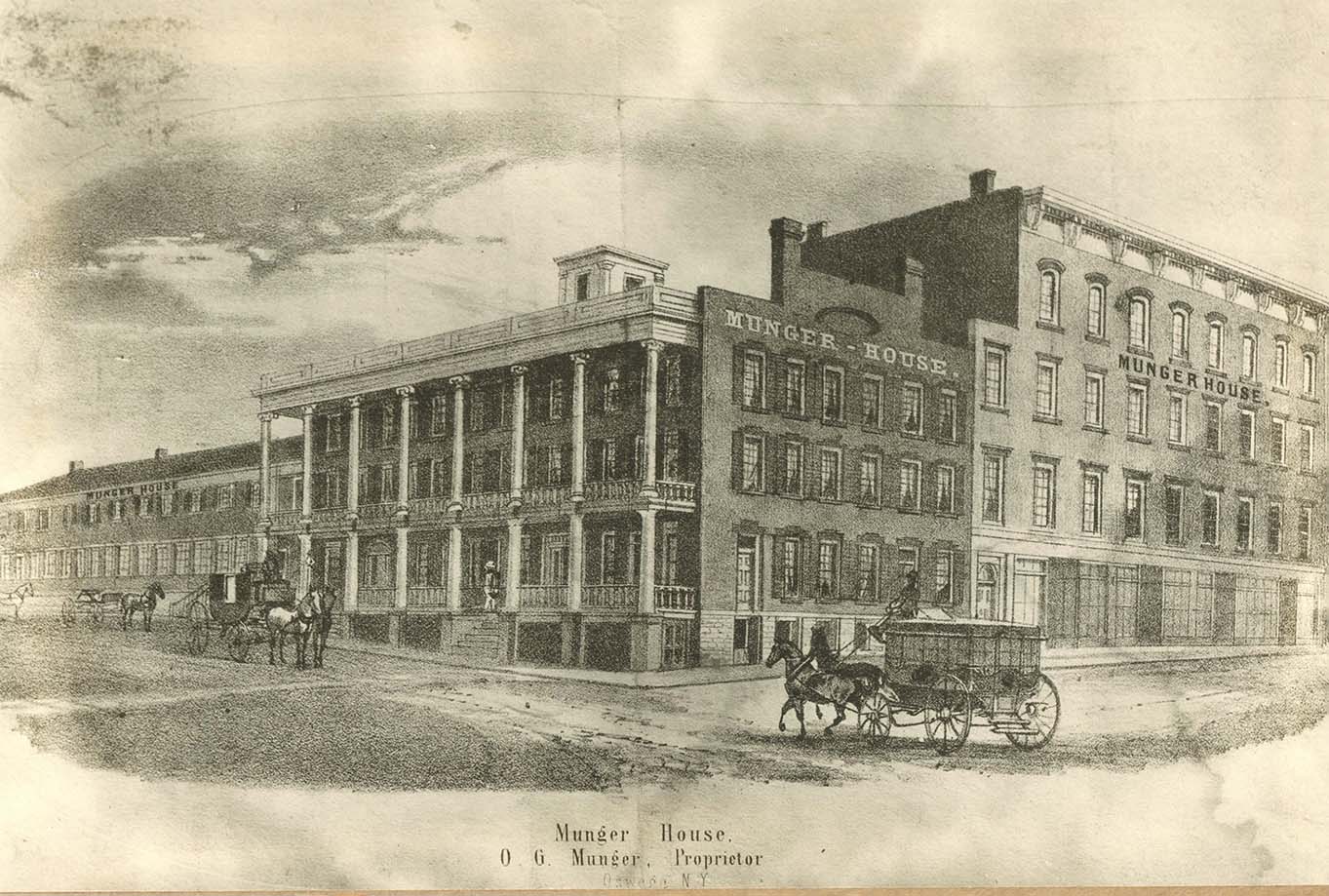
                      Altmar Cottage Hotel


One of several first class hotels in Oswego in the 19th century was the Munger House, built at the southeast corner of East Bridge and East First streets by Gerrit Smith as the "Oswego Hotel."  E. A. Huntley was the first landlord. In its fist years stores were located on the ground level and the portion of the building occupied by the hotel began as the second story. In 1835 Moses P. Hatch purchased it for $25,000. He added the porches and a cupola to improve its appearance, and made other improvements. Hatch sold the hotel a year later for $120,000 to a man named Baldwin during the height of the Oswego land boom. As Baldwin did not meet his payments, ownership reverted to Hatch and later once again into Smith's ownership. In 1840 Henry Clay addressed an audience from one of the porches of the hotel. In 1855 Smith sold it to O. G. Munger who changed its name to the "Munger House. Upon Munger's death on November 12, 1877, the name was changed to the Fitzhugh House. The main portion of the building was razed in 1887 and the Second National Bank was built on the site. (Oswego County Historical Society). 

Oswego Palladium Times, November 20, 1945

Four Horse Mail and Passenger Stage Lines 

to Utica, Rochester, Lewiston, Buffalo from Oswego

                    ___

Construction of Plank Roads Gave New Life

Lease two Lines Which Operated Over Half

 Century; Last Stage Ran in 1875

                               ____

   Years before Oswego county came into being in 1816, mails were being transported to Oswego, Fulton and to other points in the later county by men who traveled on foot or, in the summer time, on river boats, even before the first crude highways were opened to make possible the establishment of stage-lines and the awarding of mail contracts to the men who operated them.

   The first mails were carried between Onondaga (Syracuse) and Oswego by Onudiaga, Onondaga Indian chief, who traveled on foot through the woods following a blazed trail which paralleled, largely, the Seneca and Oswego (in the earliest maps, identified as the “Onondaga”) rivers.

   Later came mail routes served by men on horse back, and after the Oswego Canal was opened in 1828, by packet boats on the canal. The latter service was available during the navigation period only, and the other means of transportation had to be provided during the winter months.

   Long before the canal was constructed, however, Stage lines were operating to points now within Oswego County. It was not until after the Lake Shore Railroad was opened January 1, 1873 , that the last stage line carrying the mails within Oswego county was to be abandoned so that the stage coach era in the county extended over a period of more than 50 years.

   The first contract for carrying the mails by railroad was not let until 1849 when the Oswego &  Syracuse Railroad was awarded its first contract for transporting them between Syracuse and Oswego and intervening points. This contract was let to the road about six months after it had started operation of trains.

                         Scriba’s Road First

   The first highway to be cut through the 22 miles of intervening wilderness of Oswego was undoubtedly that constructed for George Scriba, between Rotterdam (Constantia) and Vera Cruz (modern Texas) in the year 1794. This so-called road, while of ample width, was not in any respect “improved” but the trees had been felled and the underbrush cut away. The stumps were still standing in the area of the roadway and the first ox-carts or horse-teams to attempt the journey between the two places must have been forced to do a great deal of dodging about to get through the tangle of stumps. Years were to pass before the road would become worthy of the name of a highway.

   In 1804 another road was cut through the locations  today identified as the villages of Parish, Colosse and Mexico also to terminate at Vera Cruz. Its eventual southern terminus was Rome.

  In 1806 a road financed by the State of New York that was six rods wide, was surveyed from Onondaga Hill (Onondaga county) to Ox Creek in the present town of Granby and thence to Oswego where the road terminated on what is today the west side of Oswego. Another branch of the same road ran from Ox Creek to Salt Point (Syracuse).

                             Richland Roads Late

   As late as 1808 there were no roads passable with a wagon in the entire town of Richland one of the largest towns in the county, nor were there any roads in any of the towns now included in the county which were located north or east of Richland except in the towns of Redfield and Williamstown, the former town having been one of the earliest of the county to be settled by whites.

   In 1806 C. B. Burt, appointed path-master of Oswego, cut a road along the west bank of the Oswego River between Oswego and Oswego Falls (Fulton). 

   The road today known as the “north road” running from Oswego through North Scriba to Texas, and continuing on until it effects a junction with the Scenic Highway (Route 3), was completed sometime before 1812 as a map bearing that date shows this road, a portion of which in the vicinity of Texas was constructed further north and nearer to the Lake Ontario shore than the present road. Traces of the old route are still visible on the Frank V. Stevens farms and other nearby farms in the Town of New Haven.

   Another of the early constructed roads in the county was the one running between east Oswego, as that part of the village of Oswego  which lay east of the Oswego River was then known, and Scriba. This was later extended through New Haven to Mexico.

                        First Road to Mexico

   The original road from Oswego to Mexico passed in an easterly direction through what later became known as the “Cheever district” in New Haven and from there followed closely the shore  of Lake Ontario to Oswego. By 1812 the state road built between Utica and Oswego and designed to become a mail road was passible throughout its length. It entered Scriba coming from the East over the today today known as the “Middle Road,” and then turned south to Scriba Corners.

   When the mails were first started over this road about 1812 Joseph Worden who had settled in Scriba in 1806 became mail carrier on the Utica-Oswego route, carrying the mail on horseback for a number of years before the first stagecoach line was established between Utica and Oswego. Another mounted mail carrier who served a part of this route lived in Pulaski.

   By 1810 the “Rome road” ha been completed from Rome to Williamstown and Fishville (Pulaski) to the mouth of Salmon Creek. A road also by this date running north and south Passed through Pulaski  following roughly the route of U.S. Route 11 of today.

   The road between Sackets Harbor and Oswego had been completed before 1812. It ran through Port Ontario, Texas and the northern part of New Haven into Oswego. United States regulars marched over this route in 1814, coming from Sackets Harbor to the defense of Fort Ontario at Oswego.

   New Haven post office was established in 1813. For a time that village boasted of three inns operating simultaneously after 1828 and competing for business arising in part  from the stage lines which began operating through the village in 1823 and increased both inn number and in patronage as the decade advanced.

                 Indian First Mail Carrier

   Clark’s “Onondaga” asserts the first mail carrier in Oswego was a veteran Onondaga chief, Onudiaga, who had fought with the British against the Americans at Fort Stanwix, the bloody battle of Oriskany and at Cherry Creek but who was now content fo be the mail carrier for his former conquerors. 

   In 1806 or 1807, a mail route was established between Onondaga (Syracuse) and Oswego. Once each week the mail was put in a small valise at the Onondaga Post Office ready to be started for Oswego at 4 o’clock the next morning. At 9 o’clock in the evening Onudiaga came to the Post Office and received the valise and then without uttering a word was accustomed to laying himself down on the floor of the kitchen of Judge Foreman, the postmaster, to sleep.

   At 4 o’clock in the morning he would slip through the door and start on his 40 mile foot journey to Oswego. Rain or snow, hail or sunshine it was all the same to him. Old settlers used to say that no one ever knew Onudiaga to fail to make his journey or to be delayed enroute by bad weather.

   The worse were the going conditions the greater effort the Indian chief made to increase his long Indian strides so that the people Oswego came to look for Onudiaga to pass their homes at a certain time each day as regularly as they watched for the sundown.

   The next day Onudiaga would retrace his steps to Onondaga leaving Oswego for that point at 4 o’clock in the morning and arriving  in the early evening. (Clark, Joshua V. H., Onondaga or Reminiscences of Early Times, 1849, Volume 1, PP 98-100).

   In its issue of November 29, 1823 the Oswego Palladium carried the first stagecoach advertisement it had ever published. In its news columns of the same date, it directed attention to this advertisement:

                             New Mail Stage

   In order to encourage the establishment of a regular mail stage through this section of the country, we have published an advertisement in this paper for the benefit of the concerned, and pro bono publico. 

   We have long felt the want of such a conveyance. Travelers for pleasure or business can take the stage at Utica and come to this village to take a passage on the lake, (which is navigable the greatest part of the year) for any port, or they can continue on the mail route to Rochester, Lewiston, Black Rock and Buffalo, in an expeditious manner -besides the distance to those places o this route is shorter than any other.

   We may with propriety rejoice on the acquisition of this important vehicle, not merely on account of its accommodation to travelers, but because we may safely anticipate, that at no very distant period, we shall thereby receive new from our Atlantic and commercial cities before it becomes dry - a privilege, heretofore, seldom enjoyed by us.


Oswego Palladium

November 20, 1823


               MAIL STAGE,

From Utica Through Cato Four Corners to Elbridge

The subscribers will commence running a STAGE from Utica to Cato Four Corners, once a week, on the 3d of December next, which will leave Utica every Wednesday at 4 o'clock in the morning and arrive at Hampton village at Hallock's, at 6 o'clock; from thence to Rome at 8 o'clock; Humaston's, Vienna, at 11 o'clock; Doolittle's, Camden, at 2 o'clock; Hempstead's, Williamstown, at 6 o'clock; from thence Thursday morning at 4 o'clock, start for Richland, and arrive at 8 o'clock; at Mexico, 12; New Haven, 2 o'clock; at Oswego village 6; and start from thence, Friday morning at 4 o'clock, and arrive at Hannibal at 8 o'clock, Cato four corners, at 12, and at Elbridge at 4.

On return, at Oswego, on Saturday at 6, and on Monday morning, at 4, leave Oswego for Utica, and arrive at 6 P.M. Tuesday, at Gay's Mansion House.

WARNER MITCHELL,

JOSEPH LANDON.

Westmoreland, Nov. 1, 1823


                       Hempstead’s Tavern

   From the advertisement we observe that enroute from Utica to Oswego the stagecoach stopped at “Hempstead’s” at Williamstown, Oswego County. This had been built by William Hempstead, in that section of the town early designated as “The Corners.” This was located about a mile and a half west of the present village of Williamstown. There William Hempstead had erected a tavern which he continued to conduct until his death. 

(The tavern keeper became a leading citizen of the town, and in 1834 was elected to represent it in the Board of Supervisors). 

   It was at this tavern barn that the stage horses were cared for overnight while the passengers and driver, after partaking of one of the meals for which the tavern became locally famous, slept inside the tavern as  comfortably as possible until the time came for the 5 o’clock breakfast which would be served, winter or summer, before the stage made its start for Oswego.

Where the Utica-Oswego-Cato line made its headquarters in Oswego, the advertisement of the line in the “Palladium” does not disclose, nor do Editor John H. Lord’s comments on  the new line reveal that fact either. At that time, however, there were probably only three possible options that Mitchell & Landon might consider in making the arrangements for the use of Oswego hotel facilities as the local terminal for their line.

A few years earlier Col. Eli Parsons, a Revolutionary War captain, and Archibald Fairfield, an early settler at “Mexico City” in Oswego County, were conducting taverns in Oswego, but by this time Fairfield had removed from Oswego and Parsons had died, and it was doubtful that the buildings which they had occupied were yet in use  as inns, or if they were, they would have been sufficiently commodious  to be considered as a terminus for the stage line. Matthew McNair had conducted an inn in West Oswego prior to 1810 which may or may not have been functioning a dozen years later.

   In the early 1820s at least three inns were functioning in Oswego. One of these had been built by Henry Eagle, who had come to Oswego in 1809, and was specially designed to serve as an inn. Eagle himself does not seem to have conducted the inn very long, if he did at all. 

   In 1822 he was advertising in the “Palladium” as for rent setting forth the fact that it stood at Taurus (Seneca) and West First streets “in the most central part of this village” among its other advantages.

   Whether or not Eagle had leased it in time so t hat his lessee could have handled the business of the stagecoach terminal , if perchance it was offered to him, we do not know today. 

   On the east side Orlo Steele had an inn in 1822 that stood on East Bridge street.  Steele was the first lighthouse keeper in Oswego. An advertisement, said there were some vacant lots which would be available to a possible tenant as gardening space. But this property was also being offered as available for rent at about the same time the new state line began its operations so that it is unlikely that it would have been chosen as the stagecoach terminal. 

   Guiteau’s Hotel, on the west side, however, was functioning at that time apparently as the village’s leading hotel of the period. It was thee that the “leading citizens” had gathered after the Fourth of July celebration in Oswego in 1822 for the customary special dinner which the hotels of the village were won’t to serve each year on “the Fourth” as a feature of the day’s observances with its long list of formal toasts to which some of the most distinguished guests gave responses. John Grant Jr., first judge of the county presided on this occasion and Alvin Bronson, Col. E. Bronson, Dr. Benjamin Coe, James F. Wright,  a lawyer; and Dr. Cole were among others who spoke.

   All things considered it seems probable that Guiteau’s Hotel would have been the Oswego hotel most likely to have been selected as the Oswego terminal of the stagecoach line at this time as this hotel was the largest then functioning in Oswego, first class in its appointments and patronized by the leading citizens of the community.

   It was also probably the most commodious. Located on the west side where the greatest proportion of the village population at the time resided, it was probably chosen by Mitchell & Landon as the in at which the stagecoach driver would rein in his horses at 6 o’clock at night, and discharge his passengers to partake of the good meal which would be awaiting them inside the hotel, and the comfortable night’s rest that it would undoubtedly afford.

    At 4 o’clock Friday morning, the stage would be on its way once more, however, for Hannibal, 12 miles away over a rough road, where it would arrive at 8 o’clock in the morning, and probably stop for a change of horses as well, especially if the line was carrying many passengers and a heavy load of mail that day. From Hannibal it would then move on to Cato and later to Elbridge.

                           Sunday Rest at Oswego

   The stage would be back at the Guiteau Hotel in Oswego by Saturday night, however, and its garblers would alight here at 6 o’clock to spend  and spend the night and Sunday , too, as well. But the passengers would have had no opportunity to attend church on Sunday, however, as at that time the new stage line started running into Oswego there was only one church structure in all Oswego County and that was at Colosse more than 20 miles away.

   Oswego’s first church building, the Presbyterian, was not erected until,1825. Doubtless the passengers would find plenty to engage their interest, however, during the Sunday lay-over, in walking along the Oswego waterfront, visiting old Fort Ontario and viewing the lake at sunset.

   As they would have to be astir by 3 o’clock Monday morning as the stage would start at 4 o’clock, they probably would retired for the night at 7 o’clock, or 8 o’clock at the very latest. Monday night they would spend at Hempstead’s Tavern in Williamstown, and early Tuesday evening they would reach the Mansion House in Utica. It required a full week’s time for the stage on this line to complete its round trip. On Wednesday morning at 4 o’clock, the same driver, or another, would start out to recover the route once more. 

   At “Cato Four Corners” on the west bound trip, the passenger who wished to go to Wolcott, Rochester, Lewiston and Buffalo would have the opportunity to change to another stage line which would  take them over that route.

   In later years, it would have been possible for them to change to the Oswego-Lewiston four-horse stage line either at Oswego or Hannibal, but at the time these first trips were made it is doubtful that the Oswego-Lewiston line had begun to function clear through to Oswego along the “Ridge Road” as it did in later years.


                      Van Auken Hotel, Hannibal

                             A Four Horse Line

   The Utica-Oswego-Cato line was probably a four horse stage line, because of the length of its run and the distance it had to cover. The fact that it did not at the outset make daily trips would have tended to increase the passenger-load on the single trip made each week, making it  more necessary for the stage to be drawn by four horses. 

   In advertising a mail contract to be let in 1845 for a stage mail route which would serve a major portion of the route with Mitchell & Landon started serving in 1823, the Post Office contracting division while requesting bids for a “2-horse” stage, also added that a “4-horse” line bid would “be considered.”

   In the “Palladium” of April 18, 1825 there appeared a legal notice of the dissolution of the co-partnership of Warner Mitchell and Joseph Landon, which had been operating the Utica-Oswego-Cato stage line for the preceding two years.

   The notice set forth that Mitchell would pay all debts of the firm, and that money due the firm should be paid to him. Debts due the firm and not paid by June 1 “will be handed over for collection,” the notice concluded. The change in ownership of the line through the retirement of Landon, however, did not result in the discontinuance of the line which thereafter continued to operate through Oswego for many years.

                        Historic  Ridge Road

   Quite the most dashing of the stagecoach lines which operated into and out of Oswego carrying the mails and passengers over a period of half a century was the Lewiston-Rochester-Oswego line of post coaches each drawn by four horses. This line traveled over the highway built along the “Ridge Road” (Route 104) from Lewiston to Oswego.

   On its  western end it had been established in 1817, following the completion of then state road constructed in 1815 with a $5,000 appropriation voted by the New York State Legislature for the purpose in 1814. Between the time that the road had been completed and the time when the stagecoach line started in  operation, mails between Lewiston and Rochester had been carried a part of the time by riders on horseback and part of the time boy wagons.

   The historic ridge which today parallels the south shore of Lake Ontario from the Niagara River to the Oswego River is several miles inland from the present south shore of the lake which was  larger and much deeper than it is today.

   From the earliest times the Indians found “the ridge” afforded a most convenient trail through the forests to follow when traveling from east to west or vice-versa between the Niagara and Oswego rivers. After the forts were established at Niagara and Oswego , the route came to be used more extensively as a means of communication between the two points by the Indians and two some extent by whites. After Niagara was taken from the French and became a British fort this ouse naturally increased, At times armies moved over parts of the route.

   In the early days of white men in the region, the section of “the ridge” between Rochester and Niagara came to be known as the “Niagara Ridge.” Later the portion of then ridge lying between Rochester and Oswego came to be familiarly known as the “Sodus Ridge.”

   The stage line which which began traveling over the “Sodus Ridge” roadway perhaps as early as 1818 was known the Oswego-Lewiston Stage Line. It carried both mail and passengers. J. P. Butterfield, proprietor of the White Tavern at Wolcott, was at one time both owner and manager of the Oswego-Wolcott-Rochester section of the line. The four-horse coaches moving in either direction stopped at his tavern to change horses, and both divers and passengers used to stop there, at times, as well as for sleep.

                               Oswego Terminus of Ridge Line

Leaving Oswego at 4 a.m. the Rochester-bound stages would stop at Fair Haven, 15 miles away, for the first change of horses. The distance to that point would be covered in a little more than two hours as the stages used to average about seven miles an hour in good weather.

   Other stops to change horses would be made at Wolcott, as noted, Sodus and Webster enroute. The stages remained overnight at Oswego and at Rochester and started out of these places with fresh horses in each corning.

   “Hannibalville” where roads still center today at the village corners to run in many directions, was an important junction point for stagecoaches for many years. Every morning stages left Oswego for Auburn, and Auburn for Oswego, traveling via Hannibal where a change to fresh horses was effected by all stages moving in either direction.

                            Stop-Overs at Taverns                              

   The coaches themselves had to be stoutly built as the roads they traveled were very rough even when in their best condition, and the drivers usually drove with the idea of keeping schedules rather than with the thought to the comfort of the passengers. The “Troy” and latter the “Concord’ coaches were without springs, but the bodies swung on heavy leather straps which afforded a degree of resiliency. 

   From  12 to 16 passengers could be carried in a single coach. Passengers who rode inside, protected against the weather, paid a higher rate of fare than those who rode outside and took their chances with the weather. During the winter months when there was sleighing the coaches were mounted on bob-sleds. In the springtime when the frost was emerging from the ground, the dirt roadways were full of quagmires and they were often times almost impassable.

   Taverns were found at frequent intervals along the entire route of the line where the passengers were permitted to alight for refreshments. If they wearied and desired to do so, they could break the rigors of the journey by leaving the stage at any of the taverns which happened to take their fancy and then proceed onwards aboard the next stage or the next day.

   Traffic was especially heavy in the fall after the closing of navigation on Lake Ontario and again in the spring when navigation resumed. At these periods many sailors whose work was aboard ship during the navigation season, used to travel to and from Oswego and their homes in villages along the lake shore either to board ship or upon leaving them in the late fall.

                   Floating Bridge Terrorized       

   At what was known in those days as “Sloop Landing” and later as “Resort” where today a bridge crosses an arm of Sodus Bay, with a sidewalk built along one of the sides by the  State of New York for the accommodation of fishermen who stand on the bridge in large numbers at certain period of the year while fishing, there was a sort of a floating bridge anchored upon which the stagecoaches passed over by day.

   In stormy weather waves swept over this bridge of two inch planks nailed to heavy wooden stringers. Frequently when the load was heavy the bridge would be sufficiently depressed by the weight of the stage so that water would run over the heavy floor planking. At other times storms blowing in from the lake would cause the bridge floor to rock and send floods of water over its surface.

   Timid passengers passing the point at night - the stages from Oswego often reaching the point long after dark - were often-times terrified by the experience, and heaved sighs of relief when the 700-foot float had been safely crossed. If there were ever any serious accidents resulting from these crossings, however, they have not been recorded.

   In the 1820s a stage left Wolcott in the early morning for Oswego, starting from the Enoch Turner Tavern which stood on the northwest intersection of Main Street and Maple Avenue in Wolcott where the horses were stabled overnight. 

   When conditions were favorable, the stage would reach Oswego, 28 miles away, in the late afternoon. Here the stage would remain overnight and start the return early the next morning for Wolcott and Rochester. 

  At Sodus the stage driver would stay overnight, and the following morning would resume his run into Rochester where he would remain overnight and then return to Sodus on the morning of the second day out of Oswego, and continue on to Oswego. Leonard Smith, one of the drivers of the stage line between Rochester and Oswego, served for 30 years continuously on this schedule.


Oswego County Whig, May 1, 1844

SUMMER ARRANGEMENTS FOR 1844

Rochester & Oswego Mail Stage, through three times a week - Leaving the GeneralStage Office under the Welland House, West Oswego, every Monday, Wednesday and Friday morning at 6 o’clock, passing through the villages of Little Sodus, Red Creek, Wolcott, Huron, Port Glagow, Alton, Big Sodus, Williamson, Ontario, Webster and West Penfield, and arriving at Rochester at 9 the same day.  Leaves the State Office, under the Eagle Hotel, at Rochester, every Tuesday, Thursday and Saturday morning at 6 o’clock and arrives at Oswego at 9 the same day.

   The subscribers, having become proprietors of the above route, have procured First Rate Fresh teams, and fitted up entirely new First Rate Coaches, and are prepared to carry passengers over this road with safety and the utmost despatch, and pledge themselves that no attention shall be wanted on their part to the comfort and convenience of those who may favor them with their patronage.

  Fare Through Three Dollars.

      WEST & MERRILL, Proprietors, Wolcott

Wolcott, May 1, 1844


                           Fulton Couples’ Experience

   After his retirement Smith recalled an occasion when his stage carried Mr. and Mrs. John C. Miller of Fulton to Sodus where they were removing to. The Millers were waiting to board Smith’s stage, but they had in tow their cow. 

   The animal was fed to the rear of the stage and forced to travel at the same speed as the horses when the stage moved off at the crack of the driver’s whip, whether she she liked or not. The Smiths on  arriving in Sodus tied the cow in the rear of the blacksmith shop which Smith had just purchased at Sodus and intended to operate.

   In the morning the cow was missing, having broken the rope with which she was tied. Mrs. Miller asked the stage driver as he was about to leave for Oswego to keep a sharp lookout for the missing cow. Smith did so with the result he observed the cow on the west side of Sodus Bay where the stages at that time were ferried across to the other side of the bay.

   He arranged with a neighboring farmer to care for the cow, and on he following day on his return journey over the route, tied the cow behind the coach once more and brought her back to Sodus once again. This time Mrs. Smith saw to it that the cow did not get another chance to escape.

                 Railroad Killed Stage Line

   The opening of the Lake Ontario Shore Railroad from Oswego to Lewiston put an end to the four-horse stagecoach line which had operated more than 50 hears between Oswego and Rochester, the stagecoaches retiring from the field with the expiration of the mail contract which was in force when the railroad’s first trains were run over the new road.  Stages continued to serve communities not served by railroads for many years.

   Daily stages left Oswego for Auburn, Syracuse, Utica, Rome and other points. Before the Oswego & Syracuse Railroad was opened in 1848, the stagecoach lines to these points carried thousands of passengers annually from Oswego, where they arrived on the steamer lines, over Lake Ontario, to these main-line stations on the New York Central where they boarded trains to continue their journeys homeward.

   Sometimes the number of passengers was so great that three or more stages would leave Oswego simultaneously for the same destination. The stage lines brought back  on their return journeys the mails from Albany and New York, and the west, along with passengers Oswego-bound, or lake-bound from New York, Albany and intervening points.

   The Oswego stage lines made connections with other lines at various points for such far-off places as Boston and New York. Boston-bound passengers would travel from Oswego on the Utica stage through Camden and then change at Rome to another line which would take them through the Mohawk Valley and on to Boston.

   Several days would be required for such journeys if passengers chose to remain at a convenient inn overnight and three and a half days if he elected to travel both night and day to cover the 500 mile distance. Most of the stage lines operated both night and day. 

                                County Routes in 1845

   In 1845 the Post Office Department in Washington, D.C. advertised for bids for transporting the mails to most Post Offices located in New York State. The advertisement appeared in the newspapers in January, and bids wee accepted until April 15, the government to make an award to the successful bidder in the form of a contract by May 10.

   The contracts were to be effective from July 5, 1845 to June 30, 1849, both inclusive. From the details set forth in the advertising we lean the following mail contract routes in Oswego County:

   Route 1032 - From Rome to Richland by Lee, Taberg, East Florence, Redfield, Orwell, Richland and return twice a week, 47 miles. Leave Rome every Tuesday and Friday at  6 a.m.; arrive at Richland same day by 8 p.m. Leave Richland every Monday and Friday at 6 a.m., arrive at Rome same day at 8 a.m.

   Route 1033 - From Rome by Pine, Camden, West Camden, Williamstown, West Williamstown, Sand Bank (Altmar) and Salmon River to Richland, 48 miles and back, 6 times a week in two-horse coaches. Leave Rome daily except Sunday at 6 a.m., arrive at Williamstown same day by 1 p.m. and at Richland at 4:45 p.m. Leave Richland daily except Sunday at 9 a.m., arrive at Williamstown by 1 p.m. and at Rome by 9 p.m. Proposal to carry 4-horse coach will be considered,

   Route 1040 - From Pine, Oneida County by Vienna, North Bay, West Vienna, Cleveland, Constantia and West Monroe to Central Square and back, 27 miles. Leave Pine every Monday and Thursday at 9 a.m., arrive at Central Square by 6 p.m. Leave Central Square Thursday and Friday at 6 a.m., arrive at Pine at 3 p.m.

   Route 1062 - From Colosse, Oswego County by Parish and Amboy o Camden, 22 miles, and back once a week. Leave Colosse every Wednesday at 5 a.m., arrive at Camden by 12 noon. Leave Camden every Wednesday at 1 p.m., arrive at Colosse by 6 p.m. Proposal to commence route 4 miles further distance are wanted.

   Route 1063 - From Oswego by North Sterling, Little Sodus and Red Creek  to Wolcott, 25 miles and back, three times a week in 2-horse coaches. Leave Oswego Monday, Wednesday and Friday at 5 a. m., arrive at Wolcott by 11 a.m. Leave Wolcott every Tuesday, Thursday and Saturday at 4 p.m., arrive at Oswego by 10 p.m.

                     Daily Schedules Sought

   Route 1064 - From Oswego by Scriba, New Haven and Mexico to Union Square (Maple View), 18 miles and back three times a week in two-horse coaches. Leave Oswego every Monday, Wednesday and Friday at 5 a.m., arrive at Union Square by 10 a.m. Leave Union Square every Tuesday, Thursday and Saturday at 11 a.m. and arrive at Oswego by 3 p.m. Proposals to run six times a week will be considered; also to extend route through to Williamstown 14 miles further as heretofore.

   Route 1065 - From Oswego by Cheever’s Mills (New Haven) to Texas, 13 miles and back, once a week. Leave Oswego Saturday at 1 p.m., arrive at Texas at 5 p.m. Leave Texas at 8 a.m., arrive at Oswego by 12 noon.

   Route 1066 - From Fulton by Volney, Palermo, Vermillion and Butterfly to Mexico, 18 miles and back, twice a week. Leave Fulton Tuesday and Thursday at 6 a.m., arrive at Mexico by noon. Leave Mexico Tuesday and Thursday at 1 p.m., arrive at Fulton by 6 p.m. Trip to Palermo and back to be performed on Friday between 6 a.m. and 11 a.m.

   Route 1067 - From Syracuse by and from Hinmanville to Fulton, 30 miles, during suspension of navigation, six times a week. Leave Syracuse  daily except Sunday at 9:30 a.m., arrive at Fulton 7:30 p.m. Leave Fulton daily except Sunday at 9:30 a.., arrive Syracuse by 7:30 p.m.

   Route 1068 - From Camillus to Hinmanville, via Jack’s Reef, Plainville and Lysander, 28 miles and back twice a week on Tuesdays and Thursdays.

   Route 1088 - From Auburn by Throopsville, Port Byron, Conquest, Victory, Martville, Sterling and North Sterling to Oswego, 40 miles and back, three times a week, two-horse coaches,

Leave Auburn 6 a.m. Tuesday, Thursday and Saturday, arrive at Oswego by 5 p.m. Leave Oswego Monday, Wednesday and Friday at 6 a.m., arrive at Auburn by 5 p.m.

   Route 1089 - From Auburn by Sennett, Weedsport, Cato Four Corners, Ira, Hannibal and Kinney’s Four Corners to Oswego, 42 miles and back, three times a week, two-horse coaches. Leave Monday, Wednesday and Friday at 6 a.m., arrive at Oswego by 5 p.m. Leave Owego Tuesday, Thursday and Saturday at 6 a.m., arrive at Auburn by 5 p.m. 

   Besides the mail routes already described, there were other routes being maintained in Oswego County at this time. One of these operated in both directions between Oswego and Central Square. There were others, some served by horse and wagon, some by mounted carriers. 

                  County Routes in 1845

   In 1845 the Post Office Department in Washington, D.C. advertised for bids for transporting the mails to most Post Offices located in New York State. The advertisement appeared in the newspapers in January, and bids wee accepted until April 15, the government to make an award to the successful bidder in the form of a contract by May 10.

   The contracts were to be effective from July 5, 1845 to June 30, 1849, both inclusive. From the details set forth in the advertising we lean the following mail contract routes in Oswego County:

   Route 1032 - From Rome to Richland by Lee, Taberg, East Florence, Redfield, Orwell, Richland and return twice a week, 47 miles. Leave Rome every Tuesday and Friday at  6 a.m.; arrive at Richland same day by 8 p.m. Leave Richland every Monday and Friday at 6 a.m., arrive at Rome same day at 8 a.m.

   Route 1033 - From Rome by Pine, Camden, West Camden, Williamstown, West Williamstown, Sand Bank (Altmar) and Salmon River to Richland, 48 miles and back, 6 times a week in two-horse coaches. Leave Rome daily except Sunday at 6 a.m., arrive at Williamstown same day by 1 p.m. and at Richland at 4:45 p.m. Leave Richland daily except Sunday at 9 a.m., arrive at Williamstown by 1 p.m. and at Rome by 9 p.m. Proposal to carry 4-horse coach will be considered,

   Route 1040 - From Pine, Oneida County by Vienna, North Bay, West Vienna, Cleveland, Constantia and West Monroe to Central Square and back, 27 miles. Leave Pine every Monday and Thursday at 9 a.m., arrive at Central Square by 6 p.m. Leave Central Square Thursday and Friday at 6 a.m., arrive at Pine at 3 p.m.

   Route 1062 - From Colosse, Oswego County by Parish and Amboy o Camden, 22 miles, and back once a week. Leave Colosse every Wednesday at 5 a.m., arrive at Camden by 12 noon. Leave Camden every Wednesday at 1 p.m., arrive at Colosse by 6 p.m. Proposal to commence route 4 miles further distance are wanted.

   Route 1063 - From Oswego by North Sterling, Little Sodus and Red Creek  to Wolcott, 25 miles and back, three times a week in 2-horse coaches. Leave Oswego Monday, Wednesday and Friday at 5 a. m., arrive at Wolcott by 11 a.m. Leave Wolcott every Tuesday, Thursday and Saturday at 4 p.m., arrive at Oswego by 10 p.m.

                     Daily Schedules Sought

   Route 1064 - From Oswego by Scriba, New Haven and Mexico to Union Square (Maple View), 18 miles and back three times a week in two-horse coaches. Leave Oswego every Monday, Wednesday and Friday at 5 a.m., arrive at Union Square by 10 a.m. Leave Union Square every Tuesday, Thursday and Saturday at 11 a.m. and arrive at Oswego by 3 p.m. Proposals to run six times a week will be considered; also to extend route through to Williamstown 14 miles further as heretofore.

   Route 1065 - From Oswego by Cheever’s Mills (New Haven) to Texas, 13 miles and back, once a week. Leave Oswego Saturday at 1 p.m., arrive at Texas at 5 p.m. Leave Texas at 8 a.m., arrive at Oswego by 12 noon.

   Route 1066 - From Fulton by Volney, Palermo, Vermillion and Butterfly to Mexico, 18 miles and back, twice a week. Leave Fulton Tuesday and Thursday at 6 a.m., arrive at Mexico by noon. Leave Mexico Tuesday and Thursday at 1 p.m., arrive at Fulton by 6 p.m. Trip to Palermo and back to be performed on Friday between 6 a.m. and 11 a.m.

   Route 1067 - From Syracuse by and from Hinmanville to Fulton, 30 miles, during suspension of navigation, six times a week. Leave Syracuse  daily except Sunday at 9:30 a.m., arrive at Fulton 7:30 p.m. Leave Fulton daily except Sunday at 9:30 a.., arrive Syracuse by 7:30 p.m.

   Route 1068 - From Camillus to Hinmanville, via Jack’s Reef, Plainville and Lysander, 28 miles and back twice a week on Tuesdays and Thursdays.

   Route 1088 - From Auburn by Throopsville, Port Byron, Conquest, Victory, Martville, Sterling and North Sterling to Oswego, 40 miles and back, three times a week, two-horse coaches,

Leave Auburn 6 a.m. Tuesday, Thursday and Saturday, arrive at Oswego by 5 p.m. Leave Oswego Monday, Wednesday and Friday at 6 a.m., arrive at Auburn by 5 p.m.

   Route 1089 - From Auburn by Sennett, Weedsport, Cato Four Corners, Ira, Hannibal and Kinney’s Four Corners to Oswego, 42 miles and back, three times a week, two-horse coaches. Leave Monday, Wednesday and Friday at 6 a.m., arrive at Oswego by 5 p.m. Leave Owego Tuesday, Thursday and Saturday at 6 a.m., arrive at Auburn by 5 p.m. 

   Besides the mail routes already described, there were other routes being maintained in Oswego County at this time. One of these operated in both directions between Oswego and Central Square. There were others, some served by horse and wagon, some by mounted carriers. 

                             Plank Roads Boomed Stages

   After the building of the plank roads of which so many were constructed in Oswego County, which was the pioneer in their construction, the plank roads became more popular than ever before with travelers who could now ride much more rapidly and in such greater comfort in the stagecoaches.


   Before the Oswego and Syracuse Railroad began operating trains in 1848, travelers who arrived in Oswego by steamer over Lake Ontario in the early morning, would breakfast at one of the Oswego hotels, then board stagecoaches to ride to to Rome, to Auburn or to Syracuse to board trains moving east and west over the railroad lines which were to be merged in to the New York Central System.


   The “Daily Advertiser” recorded that as many as three stages, all loaded to capacity, would leave Owego on a single morning, all bound for Rome. The other routes were probably equally popular. Returning to Oswego would come in the late afternoon or evening the stagecoaches from Rome and Auburn loaded with traveler who would spend the night in Oswego and board steamers next morning to go up or down Lake Ontario, or to cross to Kingston or York, as Toronto was then identified. Both night and day packet boats operating between Syracuse and Oswego would bring further increments of passengers to board the steamers at Oswego.


After the Oswego & Syracuse Railroad began running the business done by the stagecoach line running south orin Oswego gradually decreased, bot on the east and west lines the traffic endured for another quarter of a century.


The stage coaches which became so popular after the construction of the plank roads to Rome and Auburn used to have their Oswego terminals in the 1850s and following in large part and their terminals at the Frontier House, a large hotel, five stories high, built by a stock company, that stood on the site now occupied by the Wright and Boyle building  at the northeast corner of West Seneca and West First Streets. 


   The hotel stood in close proximity to the the passenger steamboat landings on the west side. Passengers arriving by steamer the night before would spend the night at the Frontier House and after an early morning breakfast would board the stagecoaches which drew up outside the hotel for the trip to Rome, Auburn or Syracuse as their travel routes might dictate. 


   Some of the steamers even arrived in Oswego early enough in the morning to permit passengers to breakfast her and still catch the morning stage for Rome. Jenny Lind, the famous singer who made her only record visit to Oswego in 1852 in this manner.